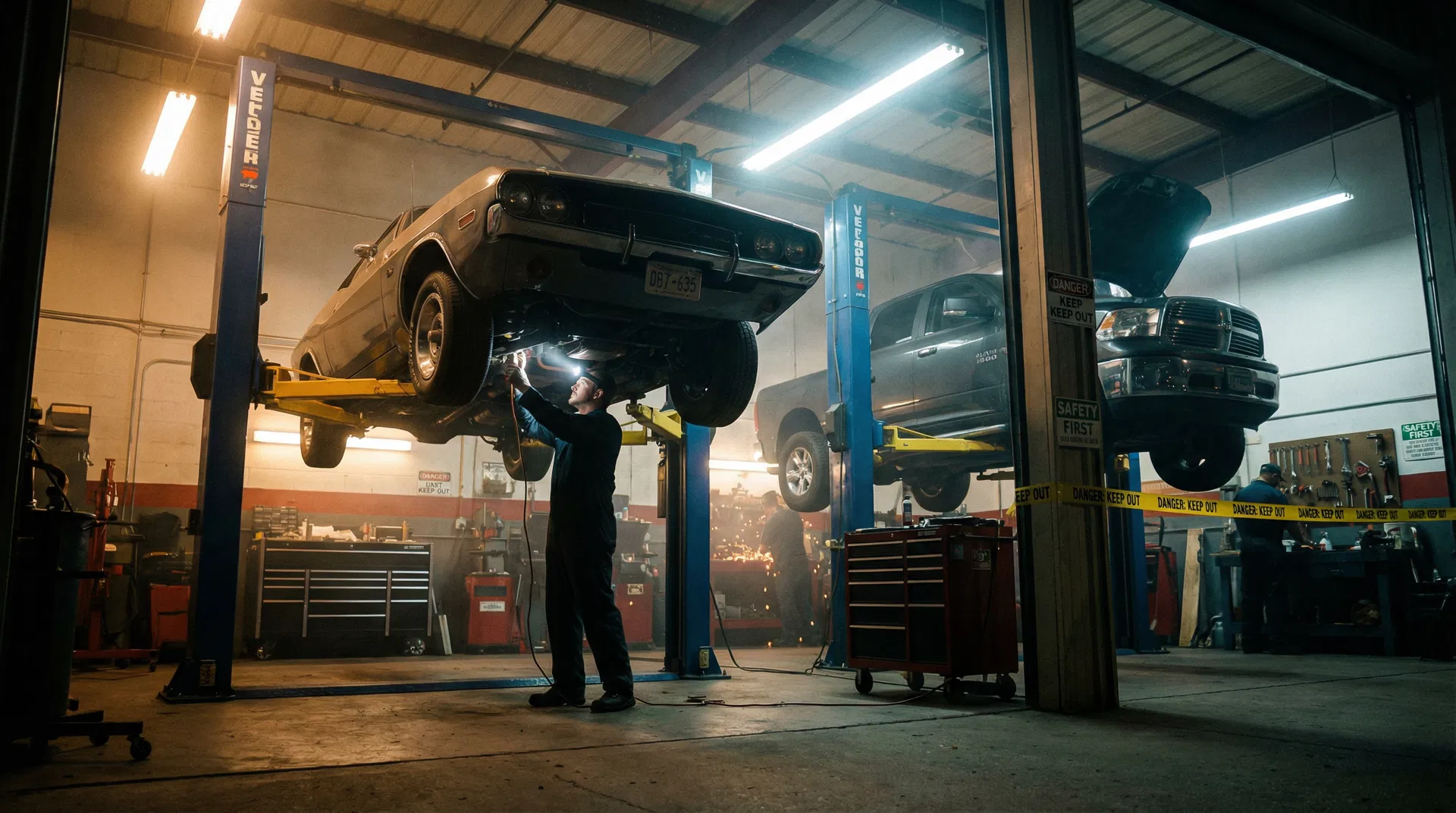
THE CLEVELAND AUTO REPAIR OWNER'S MANUAL
Most auto repair guides are written by parts manufacturers or dealer service departments — every section ends with a recommendation to buy more parts. This one's different. The honest sequence of what to fix when, the recommended-services trap, and what Cleveland salt does to cars that Phoenix shops never see.
Why this guide exists
Most auto repair guides are written by parts manufacturers, dealer service departments, or auto-chain marketing teams. Read enough of them and you'll notice the pattern: every section ends with the suggestion to buy a part, schedule a service, or upgrade to a 'premium' fluid. That's not a guide. That's a sales sequence broken into headings. The actual knowledge a Cleveland driver needs — how to read a recommended-services list without getting upsold, when synthetic oil actually matters vs when conventional is fine, what salt does to your brake lines that the inspection report doesn't mention, how to tell a battery problem from an alternator problem at the side of the road — that part rarely gets written down honestly. So we wrote it. Mechanic-owned shop on Euclid Ave, no parts kickback, fourteen sections.
The honest repair sequence — what to fix when
Not all repairs are equal. The honest priority order: safety, drivability, longevity, comfort. Safety is brakes, steering, tires, lights — fix these the day they fail. Drivability is the car running at all (battery, alternator, fuel system, ignition) — fix these the week they fail. Longevity is fluids, belts, filters, suspension wear items — fix these on schedule, not when they break. Comfort is AC, heated seats, sound systems — fix when budget allows. The chain pattern is to mix these up — recommend longevity work as if it's safety, urgent-tier the comfort work into your invoice. Every recommended-services list should be sorted into those four buckets before you sign. If the shop won't sort it for you, find another shop.
Need cleveland's local mechanic? Read the rest later.
Free written estimate. 12-month parts / 90-day labor warranty. Payment programs from 4 providers. Walk-ins welcome 7 days.
Brakes — the system, not just the pads
Most brake jobs are pads + rotors. That's what you'll be quoted. The full brake system is bigger: pads, rotors, calipers, brake lines, hardware (springs and shims), master cylinder, ABS module, fluid. In Cleveland, the salt-corrosion problems show up on calipers (seizing), brake lines (rust-pitting on the rear), and hardware (rusted slide pins). When you bring a car in for a brake job, ask the shop to check the entire system — not just measure pad thickness. A $300 pad-and-rotor job that ignores a slowly-rusting rear brake line is a fix that fails in 18 months when the line ruptures. Real brake-job pricing in Cleveland 2026: $250-$450 per axle (pads + rotors, parts + labor). Caliper replacement adds $100-200 per side. Brake fluid flush every 3 years adds $80-120. The full system inspection should be free. We do it at Nick's whether or not you buy work from us.
Oil change — synthetic vs conventional, the honest math
Synthetic oil costs more per change. Conventional oil costs more in total over the life of the engine because you change it more often. The math: synthetic at 7,500-mile interval × $80/change = $0.0107/mile. Conventional at 3,000-mile interval × $50/change = $0.0167/mile. Synthetic wins by ~36% over a 100,000-mile car. The exception: severe-duty conditions (heavy towing, lots of short trips, extreme cold) push the synthetic interval down toward 5,000 — still cheaper per mile than conventional. The dealer scam: 'manufacturer-recommended' synthetic at 3,000-mile intervals. That's neither what the manufacturer recommends nor what the oil needs. Read your owner's manual — it'll specify the actual interval. For most modern cars, the answer is 5,000-7,500 miles on synthetic. We do honest oil changes at Nick's — synthetic from $80, no upsell on filters that don't need changing yet.
Battery vs alternator — telling them apart
Both kill the car, both make it hard to start, both cause electrical weirdness. The clean test: jump the car and drive it. If it starts and runs fine after the jump but won't restart 30 minutes later → battery (jumping refilled it, but the alternator isn't keeping it charged because the battery is dead and won't hold). If it starts and runs fine and starts again next morning → battery was just discharged from a parasitic drain or cold weather. If it starts after the jump but dies while driving → alternator (it's not generating; the engine ran on the residual battery charge from the jump until that ran out). If you have a multimeter, check voltage with engine running: 13.8-14.4V is healthy alternator. 12.0-12.6V engine running means the alternator isn't charging. Battery cost in Cleveland 2026: $130-220 installed depending on group size. Alternator: $400-650 installed. Diagnose before replacing — replacing the wrong one doesn't fix the actual problem.
Check engine light — diagnostic, not parts-cannon
The check engine light tells you the car's computer detected something outside parameters. It does not tell you what part is broken. The chain pattern is to read the code and replace the part the code points at. That works ~50% of the time. The other 50%: a code that says 'oxygen sensor' is actually a vacuum leak that's reading false-lean to the sensor; a code that says 'misfire cylinder 3' is actually a fuel injector on cylinder 1 starving cylinder 3 of fuel; a code that says 'catalytic converter inefficiency' is an upstream oxygen sensor that's slowly degrading. Real diagnostic work means the shop reads the codes, then verifies the actual cause with live data, smoke testing, swap testing, or visual inspection. That takes 30-60 minutes of labor. A code-reader-and-replace shop charges you for the part and labor. A real honest shop charges you for the diagnostic time and tells you the actual fix. We do the second kind at Nick's.
Transmission — fluid, not gearbox (usually)
Transmission problems get diagnosed wrong constantly. The chain pattern: 'shifting hard' = $4,500 transmission rebuild. The reality: 8 out of 10 shifting complaints in 2010s+ vehicles are fluid-related (low fluid, dirty fluid, contaminated fluid) or sensor-related (failing solenoid, bad input/output speed sensor). A $250 transmission fluid service or $400 solenoid replacement fixes the problem. The remaining 2 out of 10 are real transmission failures that need rebuild or replacement. Don't authorize transmission rebuild or replacement without the shop demonstrating the actual mechanical failure — fluid sample analysis, scan-tool data showing erratic gear-ratio errors, or physical inspection through the inspection plug. If the shop can't show you the failure, they don't know what they're diagnosing. Get a second opinion before signing a $4,500 transmission job.
Suspension — what Cleveland roads break first
Cleveland's freeze-thaw + pothole + salt combination breaks suspension components in a specific order. Year 4-6: bushings (control arm, sway bar, motor mount) — clunking over bumps, vague steering. Year 6-8: struts/shocks — bouncy ride, longer stopping distances on rough roads. Year 8-10: ball joints, tie rod ends — clunking when turning, alignment that won't hold. Year 10+: control arms themselves, rusted-through subframe components on the worst-affected cars. Average Cleveland suspension job in 2026: $300-600 per corner (struts), $200-400 per side (control arms), $150-300 (tie rod ends). The shop should drive the car on a rough road and identify which corner is making which noise. A 'we'll just replace everything' quote without diagnosis is overselling. A 'just struts' quote when bushings are also worn is underselling. Honest diagnosis takes 20 minutes of road-test plus 20 minutes of underbody inspection.
AC + heat — refrigerant leak vs compressor
Cleveland summers don't get extreme but the AC failure pattern is consistent. Year 5-8: refrigerant leak through the high-pressure line or condenser (cooled at first, gets weak over weeks) — fix is leak detection + line/condenser repair + recharge ($200-500). Year 8-12: compressor clutch failure (no AC at all, or intermittent) — fix is clutch or full compressor ($500-1,200 installed). Year 10+: evaporator core leak inside the dashboard — labor-heavy repair ($1,200-2,000) because the dash has to come out. Heat failure is usually the heater core (rare, expensive — sometimes worth a junk car) or the blend door actuator (common, $200-400). Don't authorize AC work without a leak test — recharging a system that has a leak just buys you 3 weeks before it leaks out again. The shop should evacuate the system and pull a vacuum to test for leaks before recharging.
Exhaust + muffler — small holes vs catalytic converter
Small exhaust leaks (loud rumble at idle, gets louder when accelerating) are usually a rusted-through pipe section ($150-350 to weld in a patch or replace the pipe section). The repair is straightforward. Catalytic converter problems are different. Symptoms: engine performance loss, fuel economy drop, P0420 or P0430 trouble code, rotten-egg sulfur smell. Replacement cost: $400-1,200 for aftermarket cat-back replacement, $1,200-2,400 for OEM with manufacturer warranty. The thieves' favorite — Cleveland has had a wave of catalytic converter theft since 2020. If yours got stolen, file a police report and your insurance may cover replacement. Aftermarket converters are legal as long as they're EPA-certified — verify the part's EPA cert before installing; otherwise it'll fail E-Check.
The recommended-services list trap
Walk into most chain shops with a $50 oil change and walk out with a $400 'recommended services' list: cabin air filter, engine air filter, brake fluid flush, transmission fluid flush, coolant flush, fuel injector service, throttle body service, induction system cleaning. Some of those are real — cabin filter every 15-25k miles, engine air filter every 30-45k, brake fluid every 3 years. The rest are upsells timed wrong (transmission flush at every visit, coolant at half the interval the manufacturer recommends, throttle body 'service' for a part that doesn't need it). The honest read: bring the recommended-services list home. Compare it to your owner's manual. Anything not in the manual is optional. Anything in the manual but timed earlier than the manual specifies is a suggestion, not a need. Anything timed at the manufacturer's interval should probably be done. Shop pressure to 'do it now while we have the car' is the pressure to find another shop.
How to pick an auto repair shop in Cleveland
Chains are fine for some things — national warranty on tires (you can service them anywhere), brand familiarity, frequent coupons. Independents are better at others — diagnosis quality (single-shop indies care about each car because they see them again), transparent labor rates, used parts when used works, walk-in flexibility, written estimate before any wrench moves. Red flags at any shop: refusal to put the estimate in writing before installation. Recommended-services list that grows mid-job past your authorization. 'While we have it on the lift' upsell pressure. Closed Sunday in a 7-day-a-week city. Refusal to show you the worn part. Green flags: estimate in writing before installation. Mechanic walks you under the car with a flashlight to see the worn part. Honest about when used works vs when new is the call. Open when you're not at work. Picks up the phone with their actual name, not a call-center routing menu.
Pull up to Nick's
Nick's Tire & Auto is at 17625 Euclid Ave, Cleveland, OH 44112. Open Mon-Sat 8am-6pm and Sunday 9am-4pm. The chains close. We don't. First-come-first-served, no appointment system, walk in any day we're awake. Brakes, oil, diagnostics, transmission, suspension, electrical, AC, exhaust — full-service mechanical repair under one roof. Written estimate before any wrench moves. The mechanic quoting your work is the mechanic doing it. The yellow sign on Euclid Ave you've probably driven past. (216) 862-0005.
RELATED SERVICES
Bring it in. We'll show you the problem before we fix it.
Free written estimate before any work. 12-month parts / 90-day labor warranty. Free Uber within 5 miles if you drop off. Walk-ins welcome 7 days a week.
- 12-mo parts / 90-day labor warranty
- Payment programs from 4 providers
- Most repairs same/next day
- Text updates throughout